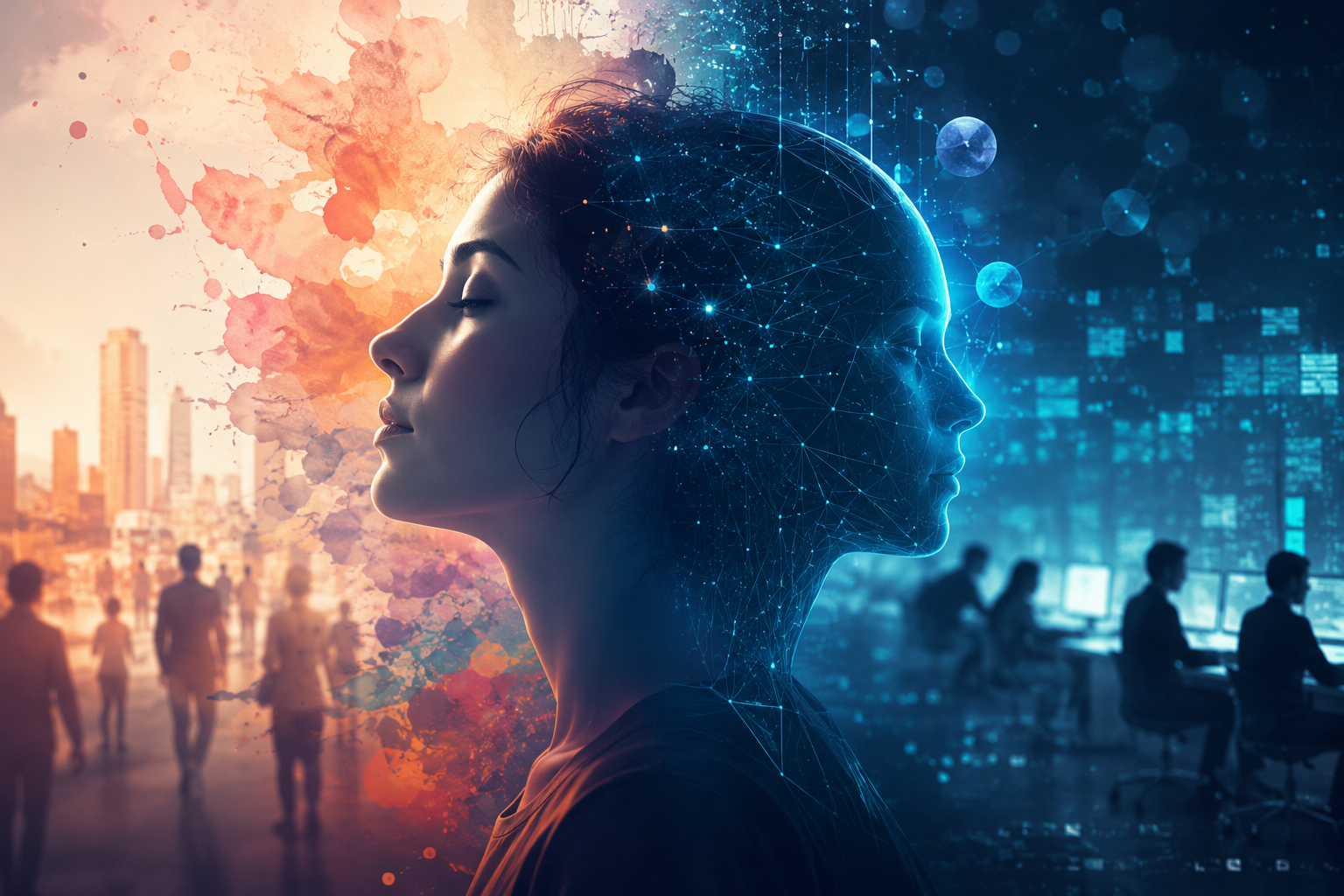
We are living through one of the most rapid technological transitions in human history. Artificial Intelligence has transitioned from a backend utility to a conversational partner, a creative assistant, and a decision-making co-pilot. But as our screens become smarter, something profound is happening behind the screens: the human mind is adapting.
The AI era isn't just changing what we do; it is changing how we think, how we process information, and how we expect digital environments to behave. Understanding this psychological shift is critical for UX/UI designers aiming to build successful products today.
1. The Era of Zero Friction and Instant Gratification
Before generative AI, users were accustomed to doing the heavy lifting. If you wanted an answer, you searched through Google, filtered out ads, read articles, and synthesized the information yourself. Today, AI does the synthesizing.
Psychologically, this is drastically reducing our tolerance for digital friction. When an AI can generate a fully coded landing page or summarize a 50-page PDF in seconds, traditional multi-step onboarding flows or complex navigation menus feel excruciatingly slow. Users are developing "AI-level expectations" across all platforms—even those that don't use AI.
2. Cognitive Offloading and The "Memory Effect"
Have you noticed how you no longer memorize phone numbers? That was the psychological impact of the smartphone. AI introduces the next level of this phenomenon: cognitive offloading of complex thought and creativity.
We are increasingly relying on AI to draft emails, structure essays, and brainstorm ideas. While this boosts productivity, it changes our cognitive load. Users are arriving at digital interfaces with more mental energy available, expecting platforms to help them refine and edit, rather than generate from scratch. Designers must shift their focus from "blank canvas" interfaces to "curation and refinement" interfaces.
3. Trust, Empathy, and the "Eliza Effect"
The "Eliza Effect" is the psychological tendency to unconsciously assume that computer behaviors are analogous to human behaviors. With conversational AI models displaying empathy, humor, and personality, humans are forming parasocial relationships with machines.
For designers, this means trust is built differently. It is no longer just about secure payment badges and clean layouts. Trust in the AI era is built on transparency, conversational tone, and contextual awareness. If a tool acts "smart," users expect it to intuitively understand their needs without explicitly being told.
4. The Illusion of Competence
Because AI makes high-level tasks so accessible, users often feel a surge in competence. A non-designer can generate stunning visuals; a non-coder can build a web app. This psychological boost is incredibly empowering.
However, when the AI misinterprets a prompt or hallucinates, the user's illusion of competence shatters, leading to extreme frustration. UX must bridge this gap by offering gentle guardrails, clear feedback loops, and intuitive error-recovery mechanisms that don't make the user feel foolish.
How Designers Should Adapt
To design for the AI-adapted mind, we must fundamentally rethink our approach to user experience:
- Prioritize Intent over Action: Move away from point-and-click interfaces to prompt-and-refine workflows.
- Design for Co-creation: Users don't want AI to do everything for them; they want to feel like a director guiding an intelligent assistant.
- Implement Friction Intentionally: While zero-friction is the goal for execution, add strategic friction before critical, irreversible AI actions.
- Embrace Transparent Confidence: Clearly communicate what the AI knows, what it doesn't, and how the user can take manual control.
Conclusion
The AI era is rewriting the rules of human psychology. As our tolerance for friction drops and our expectation for intelligent curation rises, the digital products that succeed will be the ones that deeply understand this new, AI-adapted human mind. Design is no longer just about making things look good; it is about harmonizing human intention with machine capability.